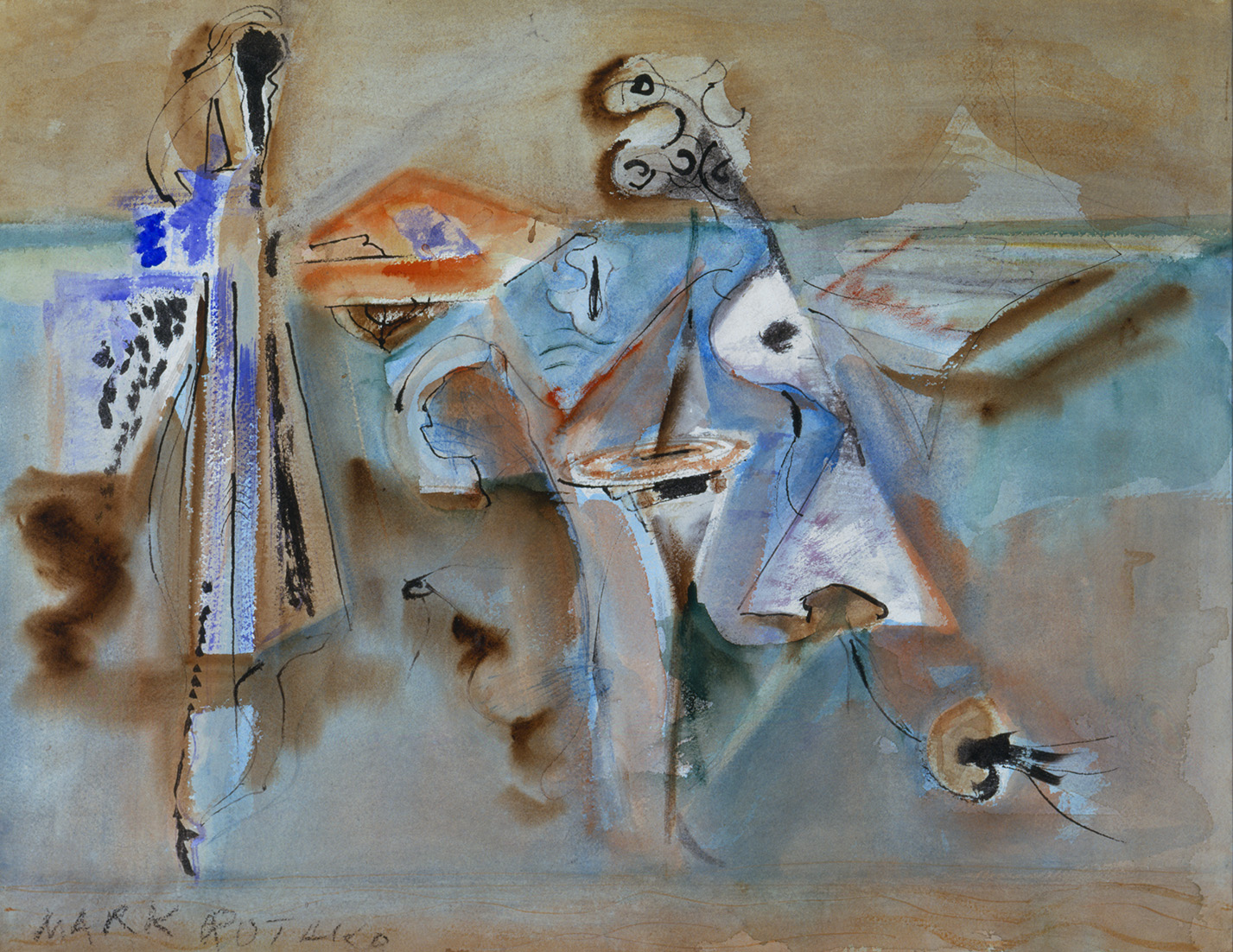
Orange. Yellow. We arrived in Florence almost 75 years after Mark Rothko. The city welcomed us with the golden spring sun and a packed schedule for a single day. Inspired by the painter, no doubt, we had chosen to divide the day into blocks to cover everything on offer. From the station, we sped towards the San Marco Museum, one of the exhibition's three venues. We walked quickly, with the joy of reuniting and the eagerness of a long-planned itinerary. Entering changed our rhythm. An old Dominican convent converted into a museum. The silence, the oblique light, the feeling of being in another world. We wandered through the rooms on the ground floor without quite understanding why we were there. Where were Rothko's works?
We went up to the cells, driven by that question. We found vibrant colors, but not the ones we were looking for. They were those of Fra Angelico's Annunciation, which greets everyone who arrives on the first floor. We kept searching. We finally found it in the first cell. A small painting hangs next to a fresco of the Dominican monk. The visual contrast is striking, the underlying spirit the same. Fra Angelico and his assistants painted a different composition in each cell to open the space to contemplation. The blues, whites, and pinks of these divine-mundane scenes resonate against the gray of the convent and propel us beyond. A wall painted so that the wall ceases to be a wall. Rothko aims for the same thing by another path, and it is in that beyond where the two meet. We didn't yet know that the city also held the opposite operation.
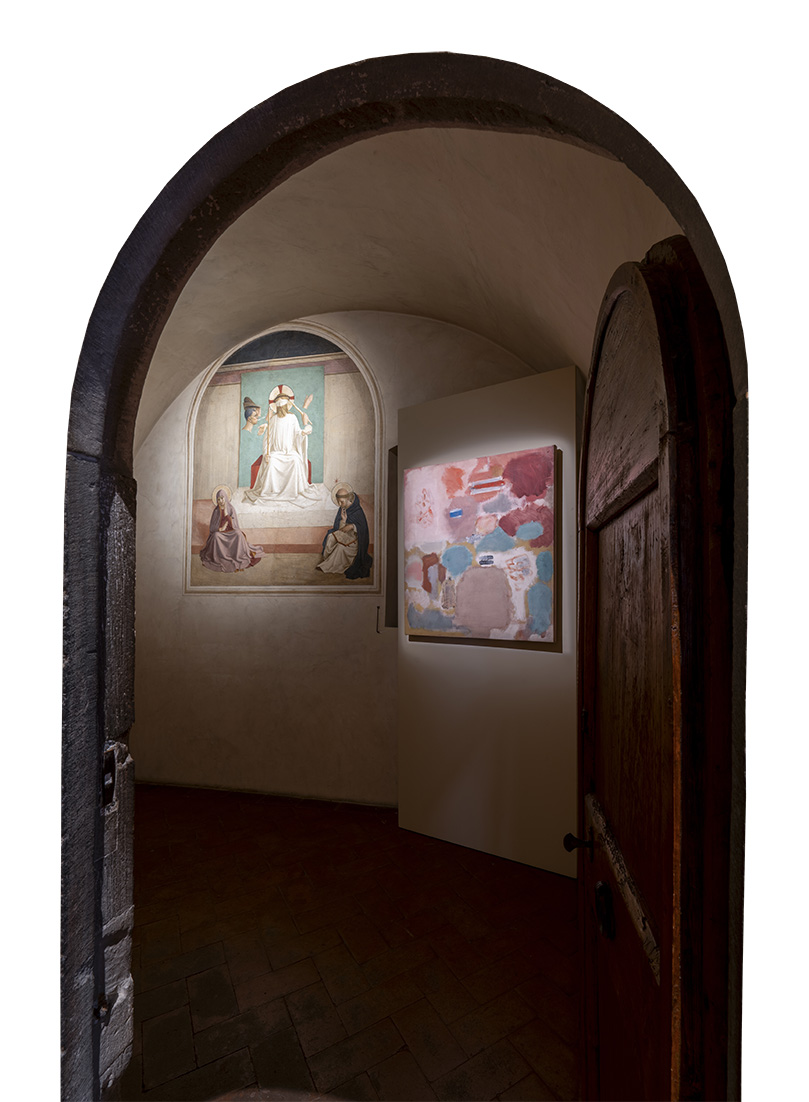
The cell of the Christ of the Risoes best explains why this exhibition exists. Fra Angelico painted a scene there that is unparalleled in the Quattrocento. Christ seated, blindfolded, holding the reed and the orb. There are no executioners around. There is a hand that slaps, another that raises a stick, a head that spits, a hat suspended in the air. Loose fragments floating on a flat background, without bodies to explain them. An image that renounces narrative and remains with the signs. Below, the Virgin and Saint Dominic sit, reading, not looking at the scene. They don't witness it, they meditate on it.
Next to it is Rothko's No. 21, from 1947. Almost a meter by a meter, oil on canvas, still without the rectangles that would make him famous. It is a Multiform. Softly outlined patches suspended on a field that is neither background nor wall, with nothing to support them, waiting for the viewer to complete what is missing. Exactly what the hands in the fresco do. And Rothko painted it three years before setting foot in Florence for the first time. Four hundred years of distance and no possible contact, but the problem is the same. How to place before a viewer that which cannot be represented without falling into anecdote. The Beatus stripped the scene to its bare bones. Rothko removed the scene entirely. We stood there for a long time, in a room two by three meters, with the uneasy feeling of watching two people who, without knowing each other, had arrived at the same place by different paths.
During the spring of 1950, Rothko made his first trip to Europe in decades. He dedicated a good part of it to Italy, and particularly to Florence, where he saw and felt the work of many Renaissance masters. The frescoes of the Beatus of Florence had a profound impact on him. He spent an entire afternoon and part of the following day studying them. He returned in 1966, on another trip, to repeat the visit. We toured the cells one by one. The effect was twofold when there was a Rothko nearby.
Red. Green. We left feeling more at ease and crossed the city to have lunch. We needed to talk about other things for a while, though we didn't manage it. The trattoria was small, noisy, with customers who seemed to come every day. The waitress recited the dishes from memory and lingered on the tomatoes longer than one would expect. She insisted so much that we accepted out of curiosity. They arrived thickly sliced, with green oil and basil. We had never seen them so red. We had never eaten them with a more pleasant flavor. Someone said that after a whole morning staring at that color, it was unfair to find it on a plate. We laughed and continued discussing what we had observed in the cells. By the time we ordered coffee, we were back in the 15th century.
From there we went to Palazzo Strozzi, which always manages to seamlessly integrate modern art into the city of David. The tour is designed as a chronological journey, and that's how we experienced it. The first room features a Rothko that almost no one expects. His work from the 1930s and 40s, still figurative, featured nudes, urban scenes, interiors, and portraits. These were painted on small panels prepared in the Renaissance style, a tangible nod to the city that surrounded us. It's surprising to learn that he came to painting after the age of twenty, almost by chance, in a drawing class in New York. Then came the neo-surrealism of the early 1940s. Greek, Roman, and Babylonian myths, biomorphic creatures seeking a common language with the viewer. Around 1946, the figure dissolved in the Multiforms. There, the irregular and vibrant patches of color first appeared. They would evolve for two or three years, becoming simpler, more ordered, until they acquired an almost architectural quality.
The rooms from the 1950s were the ones that held our attention the longest. Suspended rectangles. Extremely thin layers that seemed to emanate their own light. A palette ranging from fiery yellows and reds to cooler greens and blues. One is drawn in, but it's worth remembering that Rothko himself rejected a serene reading of his work. He spoke of an intense, even violent, energy throbbing beneath the surface. You can feel it.
The second half of the exhibition helped us understand why this show had to be held here. There are the studies for the Seagram and Harvard murals, modest in scale, in tempera on textured paper, inks, watercolors, and graphite. They show an artist measuring intervals and weights, rehearsing pauses between forms before taking them to a monumental scale. They coincide with his trips to Italy in 1950 and 1959. On the latter, he visited Paestum and Pompeii. From the faded reds of the Roman walls, and from the stillness of those spaces, came much of his sense of color and scale. In 1958, he had represented the United States at the Venice Biennale. From then on, his palette thickened. Garnets, browns, blacks. Thin layers that range from muted brick to fiery crimson. Compressed fields where the light struggles to break through. Standing before them, one understands the phrase repeated on the posters. There is no serenity, only emotion held at the edge of darkness.
The finale is more intimate. The last decade was occupied by public commissions that pushed him to paint in series. Then came the years of working almost exclusively on paper. In 1969, he returned to canvas with the eighteen Black and Grey works, the first painted in acrylic, framed by a white border that defines the plane unambiguously. The final rooms bring together the series on paper from his last months. Some are so dark that you have to stay for several minutes until your eye adjusts and begins to distinguish what's inside. Others, in soft blues, pinkish earth tones, and terracotta, seem almost Quattrocento. They are the most personal works in the exhibition. Also the ones that imposed the most silence on our group.
After all that weight, we needed air. We stopped at a nearby bookstore that also functions as a cinema. We sank into our seats until exhaustion almost overcame us. We went out for ice cream.
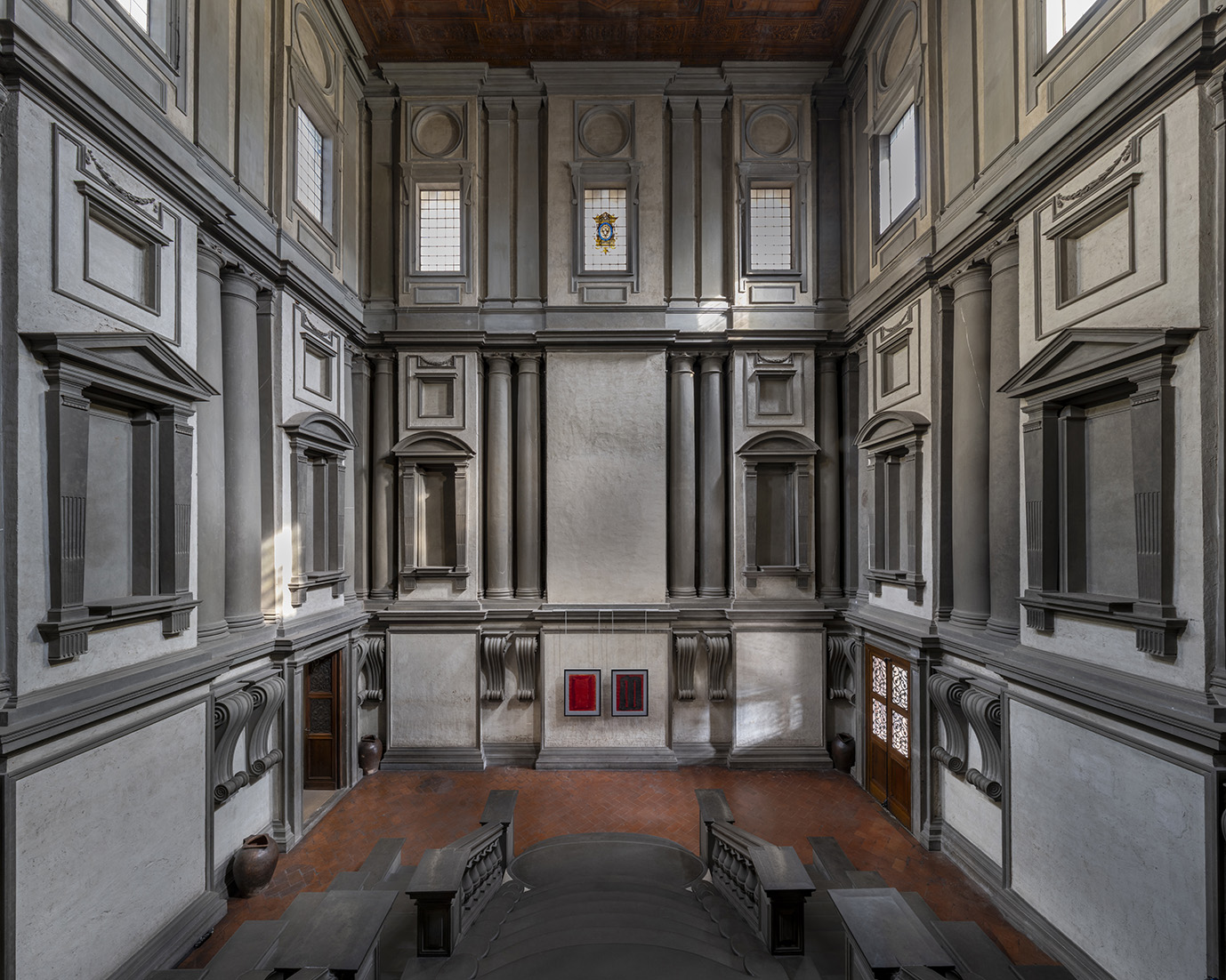
Gray. Black. The Laurentian Library is Rothko in space. Or vice versa, Rothko is Michelangelo in color. We arrived at San Lorenzo at dusk and climbed the stairs to the lobby, dragging the entire day along. No explanation was necessary. The space does the work on its own. The columns embedded in the wall, the corbels that support nothing, the blank windows, the staircase that spills out onto whoever enters. Everything is designed so that the body understands before the head. You remain there, contained, with no obvious way out, your gaze drawn upwards and nowhere in particular. Rothko passed through here in 1950, when he had only recently begun developing the language that would make him recognizable. What he took away was not a form but an idea: that an artist can completely control what happens to someone inside a room.
Nine years later, while finishing the Seagram Museum murals, he admitted that he had been working under the unconscious influence of these walls. He was looking, he said, for that same feeling of being locked in a room with the doors and windows boarded up, with no option but to bang his head against the wall. That feeling one experiences today at the Tate Modern, where the Seagrams surround the visitor, appears here in its origin and in its simplest form. There are two preparatory studies hanging in the lobby. Small, almost timid in the face of the architecture. They don't compete with Michelangelo, they point to him.
Orange. Yellow. Again. Florence gave Rothko a visual language that reflected his own explorations. The frescoes of the Beatus offered him openness, a wall opening onto the transcendent. The Laurentian Gallery showed him the inverse operation, enclosure, the weight he would later pursue in the closed canvases of the 1960s. He needed both together, and he understood them here. In this city, and in its masters, he recognized an architecture of silence that would ultimately define his work.
We finished with a beer on the banks of the Arno, sitting down, not wanting to analyze anything further. We had talked all day about fields of color, thresholds, light emanating from within. Now we watched as those same yellows and oranges that had greeted us that morning hid behind the city. Orange, yellow, red, green, gray, black. We began this journey in cells with openings in the wall and ended in a room that doesn't let anyone out.
* Special for Hilario. Arts, Letters, Crafts