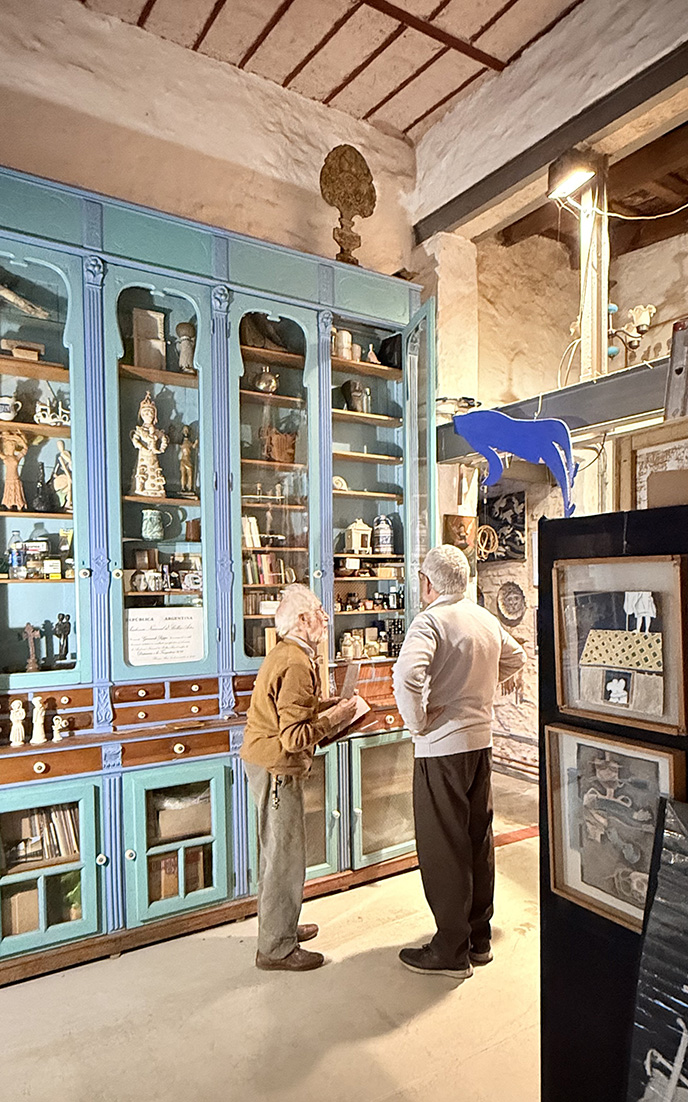
In contemporary art, being a firsthand witness to the genesis of a work, experiencing that magical act of creation, lends a special character to its subsequent possession.
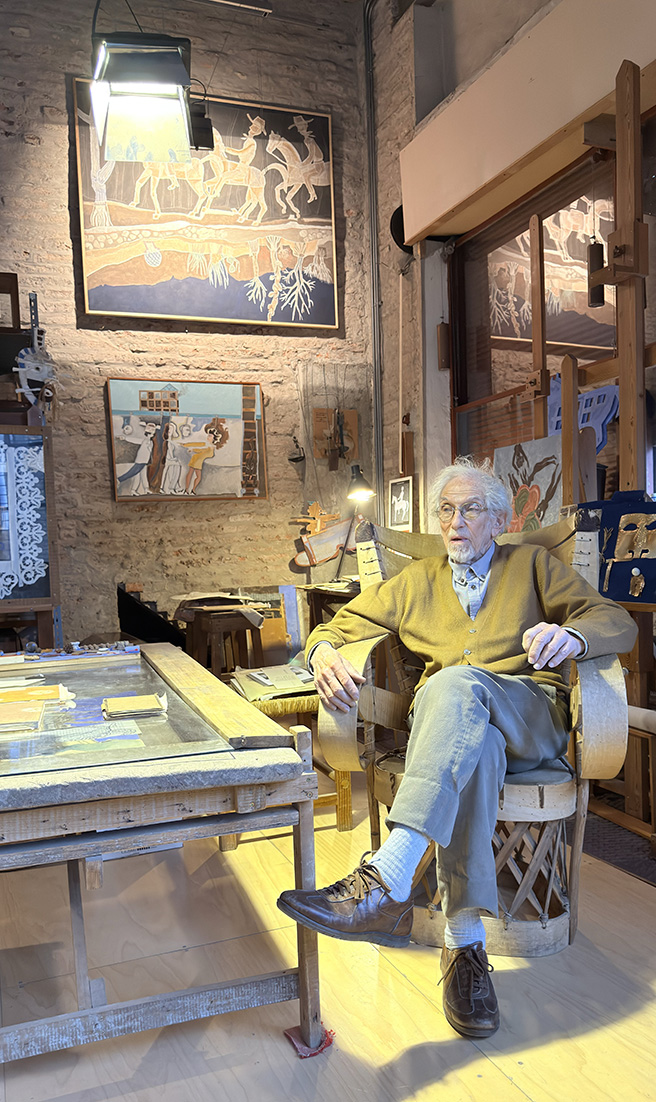
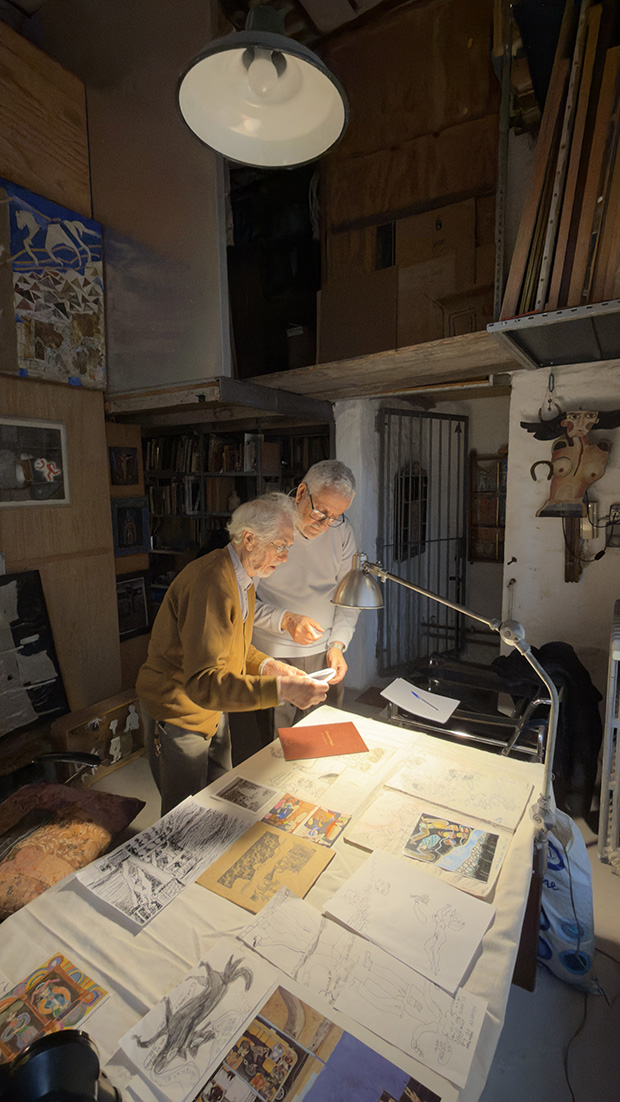
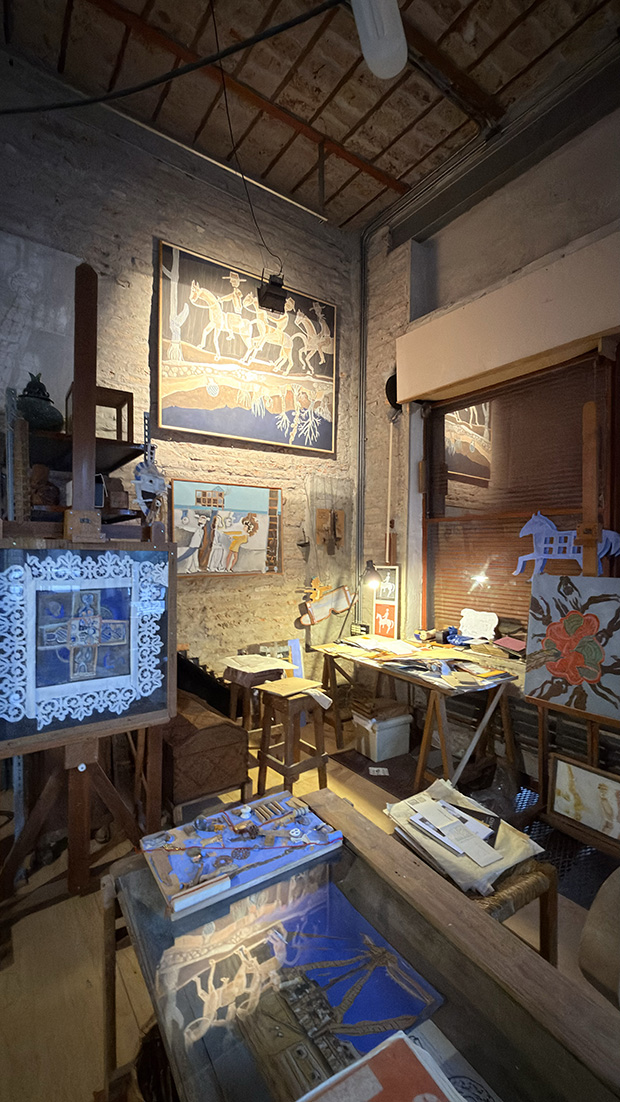
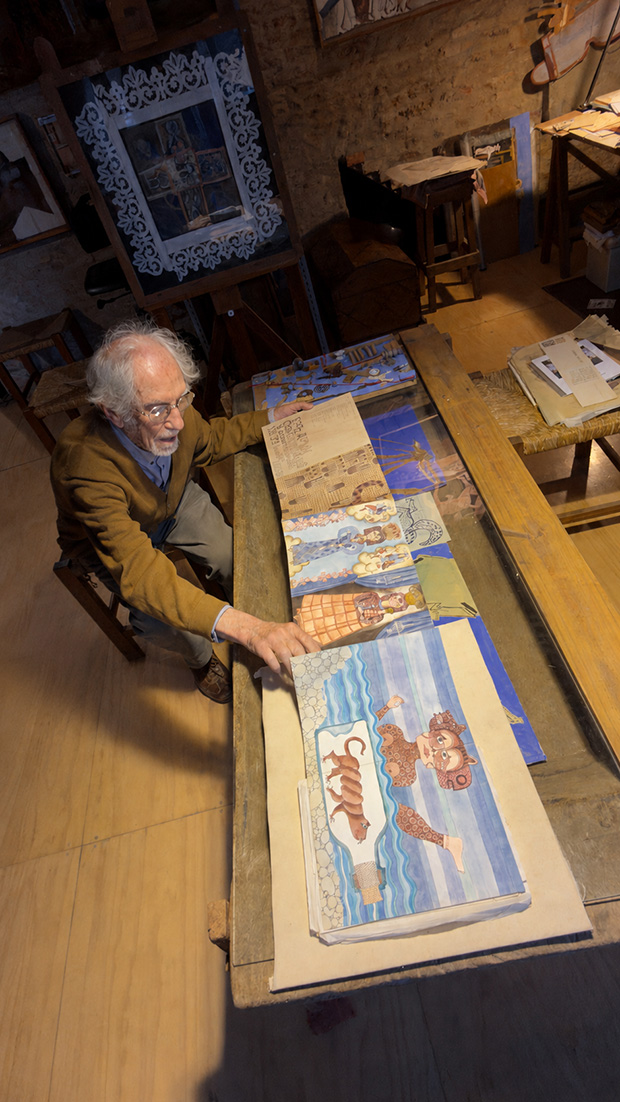
A few days ago, we visited the studio of Giancarlo Puppo [1938], and his youthful 87 years filled us with a singular enthusiasm. Overflowing with his own works and objects collected from different eras, places, techniques, and materials, his workspace welcomes him every day. Day after day, he immerses himself in new creations, guided by an infinite desire to play with the mysteries of art and, we sense, to transcend.
"I come every day," he told us, "and in recent months, the themes that inspire me most lead me to work with festive scenes and ships. Look at 'The Ship of Fools'—a beautiful work hanging on one of the walls of his studio—the sails billowing to either side… and the figures climb the masts and soar upwards." There they are in Piazzale Roma and at the Parthenon… They’re all crazy,” he says, and sharing his mischievousness, while laughing, he adds, “Me too, I’m getting a little crazier every day. Luckily, I don’t kill anyone… although there are moments… But no, I would be capable of killing anyone or anything.”
With a firm character, his humor accompanies us throughout the visit, and it’s contagious. The experience was inspiring. His stories and his creations are astonishing.
With those vivid impressions, we believe that a visit to his studio should be a mandatory stop on the tours organized to welcome—and charm—the directors of art institutions, curators, critics, and collectors who arrive in Buenos Aires for each edition of ArteBA.
Born in Rome, Giancarlo arrived in Buenos Aires with his family in 1947. An architect by training from the University of Buenos Aires and the University of Uruguay, he practiced his profession in association with distinguished figures, such as Clorindo Testa. Together with Ethel Etcheverry, co-owner of the Puppo Arquitectos studio, he developed his own brand in this discipline. A university professor, lecturer, and responsible for some one hundred and forty projects and almost one hundred works in Spain, Italy, and on both sides of the Río de la Plata, his innate curiosity led him directly to the universe of art.
An initiatory journey through his native Europe in 1961 exposed him to a fascinating array of architectural and pictorial repertoire, captivating him with the traces of past civilizations. This intellectual and emotionally charged path was replicated in the following decade, not only in the Old World but also throughout the Americas. By then, his art already revealed a striking personality.
Since 1965, he has been part of the roster of artists at the emblematic Argentine gallery, Galería Bonino, and his work has been featured in more than a hundred exhibitions, most notably the retrospective presented at the National Museum of Fine Arts in Buenos Aires in 2005.
For José Emilio Burucúa, he is a Renaissance figure in our time. His devotion to laughter is evident in his irreverent imagination; Burucúa explains it with precision, describing "the unfolding of an imagination that we see encompassing everything from tragic anguish and plastic disintegration [in the human figure, in the landscape] to the grace and parody of multiplied movements, of characters freed from all kinds of burdens [sexual, spiritual, ethical], transformed into actors in a comedy.
Giancarlo combines, on the one hand, in his storytelling through images, the splendor of transparencies, glazes, and polychromy, achieved with watercolor [almost a miracle of technique], and, on the other hand, the decomposition of the silhouettes of characters and animals into heads, arms, and legs, multiplied as if they were pieces of various puzzles, creating a kinetic, playful, and melancholically archaic effect."

Brushes and other tools necessary for his artistic endeavors. Photograph: Nicolás Vega.
It's clear he loves mixing and matching, using different techniques and materials—including soil samples collected on his travels—in a style that is both contemporary and uniquely classical.
Regarding his style, the Italian essayist and art critic Gillo Dorfles aptly describes it: "Here is a truly unusual case in the current painting scene: that of Giancarlo Puppo, who, alongside his architectural practice, has long been developing a fascinating and disconcerting art form that could be described as iconographic. In the most literal sense of the term, that is, a creator of icons." [1]
Stored in a hidden corner of the web—and today you're just a step away from reaching it [VER]—we want to focus on some excerpts from the dialogue between the artist and Gillo Dorfles [1910-2018], that guru of contemporary art, psychiatrist, art critic, painter, professor, and philosopher born in Trieste when it still belonged to the Austro-Hungarian Empire.
The back-and-forth of questions and answers between these two friends is not to be missed, but we must concentrate on some of the topics addressed for reasons of brevity.
Dialogue between Gillo Dorfles and Giancarlo Puppo at Casa Dorfles [Milan, Italy, 2004]
The interview begins with a series of questions posed by Puppo, always referring to his artwork, which inspires the remarkable Dorfles.
Gillo Dorfles: From these few questions, many extremely important issues already emerge that must be considered in the case of your painting, precisely because it is a type of painting that departs markedly from what is currently happening. The present corresponds to a period that is indeed frequently far removed from figuration. And the very fact that figuration constantly appears in your work makes your art clearly distinct from the more widespread kind. But when we say "figuration," it is immediately necessary to specify: a non-realistic, non-mimetic figuration, that is to say, exclusively invented, of absolute inventiveness. And so, I think that one of the elements that most differentiates your work from the general trend is the creation of a fantastic world in which both human and animal forms live and thrive, as well as "animalized" or "humanized" objects; therefore, a kind of synthesis between the corporeal, the zoomorphic, and the anthropomorphic, from which completely original figurations result, which cannot, in reality, be compared to those of any contemporary artist. Which I find very important. In other words, while a surrealist origin might initially be assumed, this idea is immediately dismissed because, in your case, we find nothing dreamlike or automatic, as in surrealism, but rather highly elaborate constructions from a mental perspective. That is to say, these are not purely random improvisations.
Giancarlo Puppo: Your observation, which separates me from Surrealism, is interesting and novel. Occasionally, some critics have linked my painting to aspects of that movement or attributed a dreamlike or unconscious origin to my images.
G.D.: Absolutely not. Furthermore, at a certain level, the technical factor comes into play, which is always important in all art forms. But in our case, the technical factor has a very particular relevance because we observe a very precise search in some specific pictorial systems: the timbral use of color, the frequently three-dimensional representation, the disregard for traditional perspective, the use of an invented system of spatial coordinates. This, too, seems to me a very interesting aspect, and I don't know if it has been noted by others who have studied your work. What has surprised me from the very beginning is the duplication or multiplication of spatial elements.
G.P.: Are you referring to possible different points of view?
G.D.: To points of view, yes. We don't have, then, a central viewpoint, nor a "high" viewpoint of the kind found in Japanese painting, but we do almost always have a fragmentation of the image. This fragmentation can even stem from the tomography and graphic elements of the work itself, or from the juxtaposition of images that create, in a certain sense, what I've considered important from the outset: the narrative. It's not...
G.P.: Excuse my interruption, Gillo, but do you think this visual multiplicity—but "visual" is a misnomer; let's say a multiplicity of observations—
G.D.: Of viewpoints.
G.P.: That multiplicity, of viewpoints, of non-coinciding points of observation, I wonder, does it allow for a better development of the narrative?
G.D.: Yes. I think there's greater freedom of action because, naturally, not being slaves to perspective, symmetry, or the usual spatial dimensions allows for imaginative play that would otherwise be inadmissible.
Thus, for example, the accumulation of figures, the chase among many characters with no regard whatsoever for their spatial positioning: silhouettes suspended in the air, contrasting silhouettes, decidedly inverted silhouettes. All of this seems very unusual to me. And I must say that the only thing these images sometimes make me reflect on [naturally, let's take this observation with caution] is in relation to some works by schizophrenics. For example, the work of Wölffli, the famous schizophrenic who was interned in the Zurich Hospital for interminable years […]
A consummate and brilliant artist, but one who, as if spurred on by his madness, presented an accumulation of figures or the presence of figures completely immune to any spatial considerations, for example, placed in circles or upside down. Now, what Wolffian did, undermined by a hallucinatory psychosis, in your case is naturally done with full awareness and self-criticism [...]
Technique and its Tempo
G.P.: On the other hand, I have a constant preoccupation with technique. [...] what refers to the execution of the work. Which begins with the choice of canvas and its preparation. But it also has to do with what Calvino says—you will have read it—in the "American Lectures." In the introduction, he analyzes "how to begin and how to finish." For me, beginning is always easier [...] whether it's a painting or an architectural project, I always find it easier to begin.
G.D.: Is continuing more difficult?
G.P.: No, the difficult thing is knowing how to finish, or rather, where. That's the critical point. It is for me; perhaps it's a personal quirk; perhaps this isn't true for everyone and can't be generalized. Perhaps some find it difficult to finish, and others find it difficult to finish both.
G.D.: No, but since your works are frequently fragmentary, there's no need to finish them; they remain at the level of fragments, and the completion must be done on a technical level [...]
G.P.: But the element of chance bothers me. If one solution is interchangeable with another, the choice worries me; one must be better than the other. And how do you know if the work is completely finished with that option? Look, for example, at "Andrea"—it was a work in progress for a year and a half; months and months deciding on fragment after fragment, changing the composition, adding one panel after another…
G.D.: It's strange. Why was it like that?
G.P.: It never seemed to be in order. I always found something out of place. My paintings, you're right, are deceptively simple. They're very labored, but I do my best to make it invisible. We've heard so many times, "He's worked on that piece for years, tenaciously..." and I think, why should we suffer the consequences? Nothing is worse than a work that betrays fatigue. A work should be clear, spontaneous, limpid—think of Scarlatti or Debussy…and this certainly relates to the finished work. Sometimes I return to a painting, changing or adding parts years later; I hope it's not apparent, that the work remains fresh, neither forced nor worn. And yet there is an element of patience. Sometimes I think the work matures on its own, like fruit on a tree. Or is it we who mature and see things differently?
Sources and the Absurd
G.D.: You published that book on Pre-Columbian America, on Pre-Columbian Argentina [2]. Now, indeed, I remember that when I first saw the Olmec, Mayan, Aztec works... I immediately had the feeling of perceiving something very close to my own way of seeing the image, much more so than what I saw in works from, I don't know, India or elsewhere. So I think that in general there is something more—the word "modern" doesn't mean anything—something closer to our way of experiencing figuration in Mayan, Aztec, or Incan works than what we find in those from Egypt, or India, and so on. Which doesn't mean better or worse; there is a kind of affinity here, and this is perhaps due to the fact that perspective, symmetry, and all the coordinates we inherited from Greece and the Renaissance are nonexistent in these Pre-Columbian works. They are completely superseded. It is, therefore, an affinity that comes from having transcended plasticity.
G.P.: Would you say it refers to the overcoming of the image understood as a photographic likeness?
G.D.: Yes, both the realistic mimetic ones and those of Apollonian beauty from the Renaissance.
G.P.: Because the canons commonly used are those inherited from Greece, while pre-Columbian America had a particular disdain for exact proportions; moreover, I suspect they intentionally altered them. They had another code, another type of non-European beauty.
G.D.: The fact that Picasso, Ozenfant, and many artists of the Cubist period referred to African imagery has the same reason. Only, pre-Columbian imagery is much more evolved than African imagery. Because African imagery is simply primitive, while pre-Columbian imagery is anything but. Therefore, very far removed from the classical ideal, although very complex in its formulation. This explains why some of your figures exhibit a primitivism that is not African or tribal, but rather, if anything, that of pre-Columbian civilizations.
G.P.: In short, you believe that my sources of information and training refer to imaginaries foreign to that of classical European antiquity. This would be related to those of pre-Columbian art or any art far removed from classicism: the art of southern Italy, Sardinian, Etruscan in Italy, or that of non-European areas. But when we speak of imaginaries, we are still speaking of figuration.
I think that non-figurative geometric art—concrete, kinetic, and others—having run its course, has little left to offer us. I don't use the term "abstract" because all forms of art are abstract, including photography. Otherwise, what do a Scarlatti sonata or an Alvar Aalto building represent if not their uniqueness?
The absence of figuration offers few freedoms: it allows neither narrative nor humor, nor critique. Within geometry, the latter two can only be expressed as intention through a title, whether concise or detailed—that is to say, through a simile. But never the first, narrative, which unfolds in time.
Therefore, it seems to me that, for my purposes, figuration is the most suitable mode of communication. And, moreover, the only one.
Notes:
1. Giancarlo Puppo, Amorosestranecreature / Amorosas extrañas criaturas, Electa, Milan, 2001. With an Introduction by Gillo Dorfles.
2. Giancarlo Puppo, Arte argentino antes / Argentine art before, Hualfin ediciones, Buenos Aires, 1980.