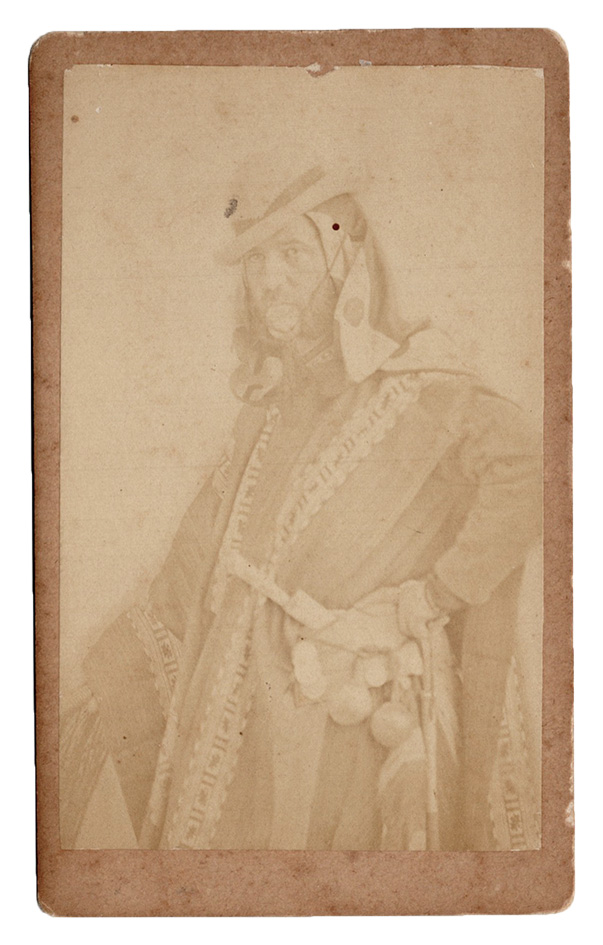
Portrait of a gaucho. Argentina. Circa 1870.
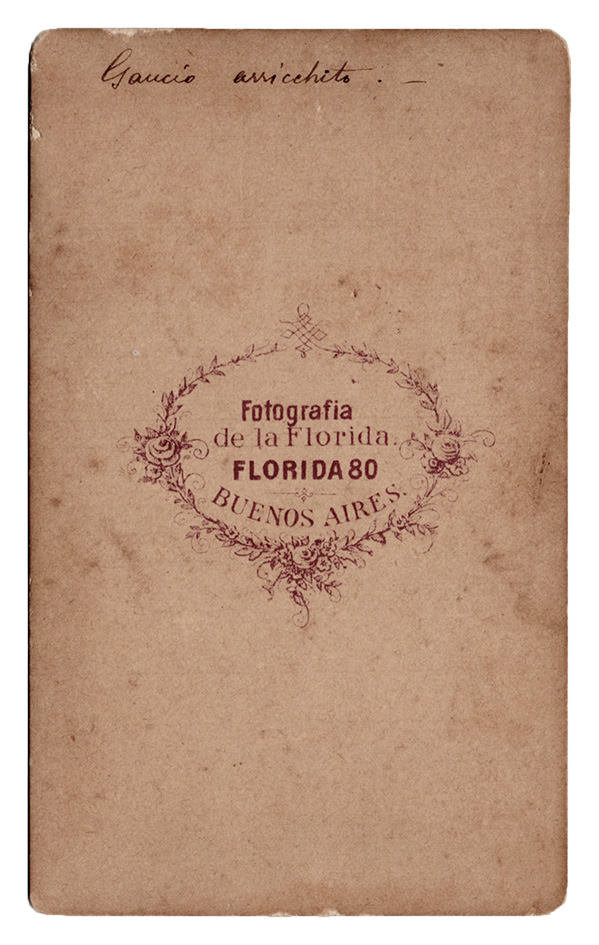
Vintage photograph—an albumen print in *carte-de-visite* format, mounted on the photographer’s branded cardstock. The reverse bears two inscriptions: one handwritten in Italian, “Gaucio arricchito” (meaning “enriched” or “wealthy” *gaucho*), and a printed (lithographic) one: “Fotografía de la Florida, Florida 80, Buenos Aires.”
Dimensions: Photograph, 9.2 x 5.5 cm; mount, 10.4 x 6.2 cm.
The image is faded, yet it serves as a significant iconographic record. Formerly in the César Gotta collection.
“The three-quarter portrait depicts a man who has adopted the *criollo* (native Argentine) style—evidenced by the correct way he has tied his *potreras* (a type of *boleadora* or throwing weapon). This detail speaks volumes about the subject—or perhaps about the set designer, who clearly possessed expert knowledge of the matter. He wears a patterned *poncho*, tucked into his belt in a way that reveals the three clasps of his *rastra* (a decorative, ornate belt buckle). Coins are affixed to the belt, and a large knife—appearing to be made of silver—is tucked in, worn in the *correntino* style (slanted across the front). On his wrist hangs a *rebenque* (whip/crop), though its specific type is not clearly discernible. On his head, he wears a kerchief with an unusual pattern, draped over a typical hat of the era—a short-brimmed style—complete with a chin strap ending in a tassel. Judging by the appearance of his beard, I would suggest he is an Irishman who has adopted the *criollo* lifestyle.” (1)
These items of attire speak to a rustic, rural form of luxury—which, in the eyes of the photographer, reflects the status of an “enriched” *gaucho*, as noted on the photograph’s mount itself. The truth is that, even in those years, all the horsemen living in the rural areas of our country took a special interest in items crafted by silversmiths who had opened workshops throughout the region. They also incorporated into their daily attire ponchos featuring complex, striped designs—as can be clearly observed, for instance, in the paintings of Pallière.
The photographic establishment—identified by its address at 80 Florida Street, located on one of the city’s most iconic thoroughfares—housed several different studios over time, including that of the American Artur Terry, who set up his business there in 1861. Available information suggests that, around 1864, Terry sold the establishment to Fufs Gastari, who was likely responsible for the collection presented here. (2)
Notes:
1. We are grateful for the information provided by Juan Miguel Arbuco.
2. Fernando San Martín: *Diccionario biográfico de fotógrafos en Argentina* [Biographical Dictionary of Photographers in Argentina]. Gráfica Laiglon, Quilmes, 2023, pp. 237 and 369.
Abel Alexander
President of the Ibero-American Society for the History of Photography
| AUTHOR | FOTOGRAFÍA FLORIDA 80 |
|---|---|
| PRICE | U$S 200 |
Are you interested in selling some works?
Send us an email briefly indicating
which works you intend to put on sale, and we will respond. click here
Subscribe to our newsletter to be updated.
Check our Newsletters