BACK TO TOP
ART
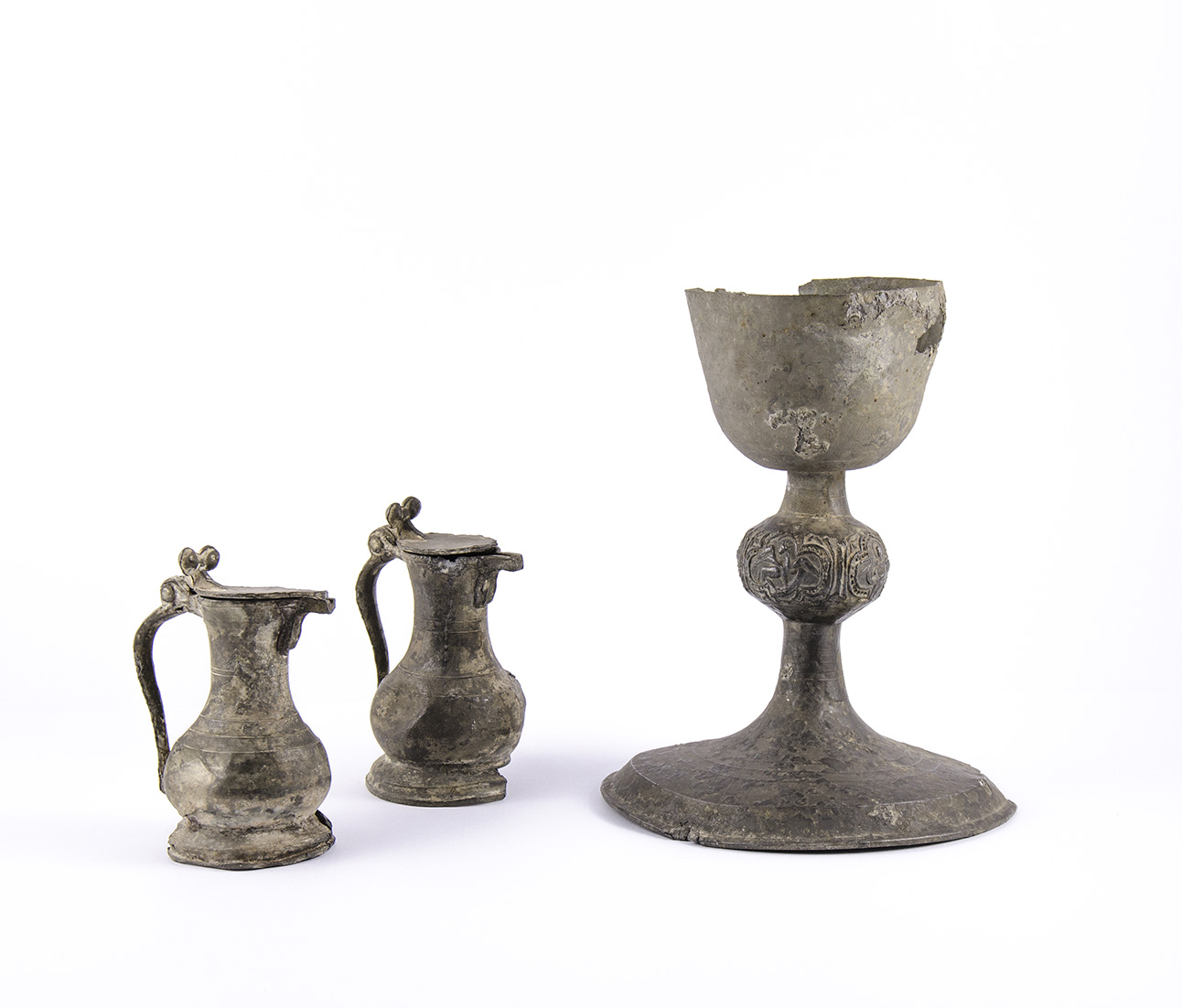
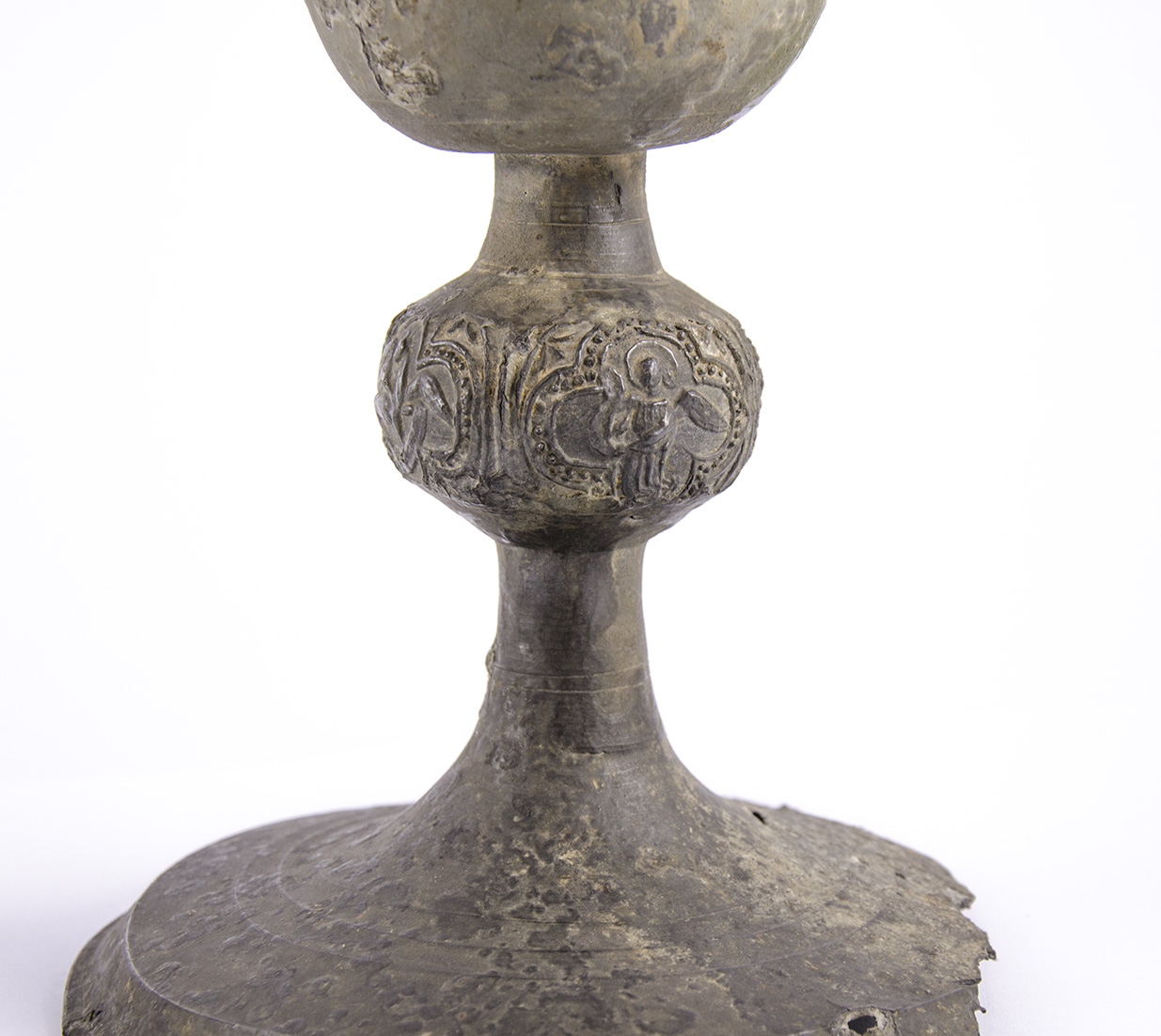
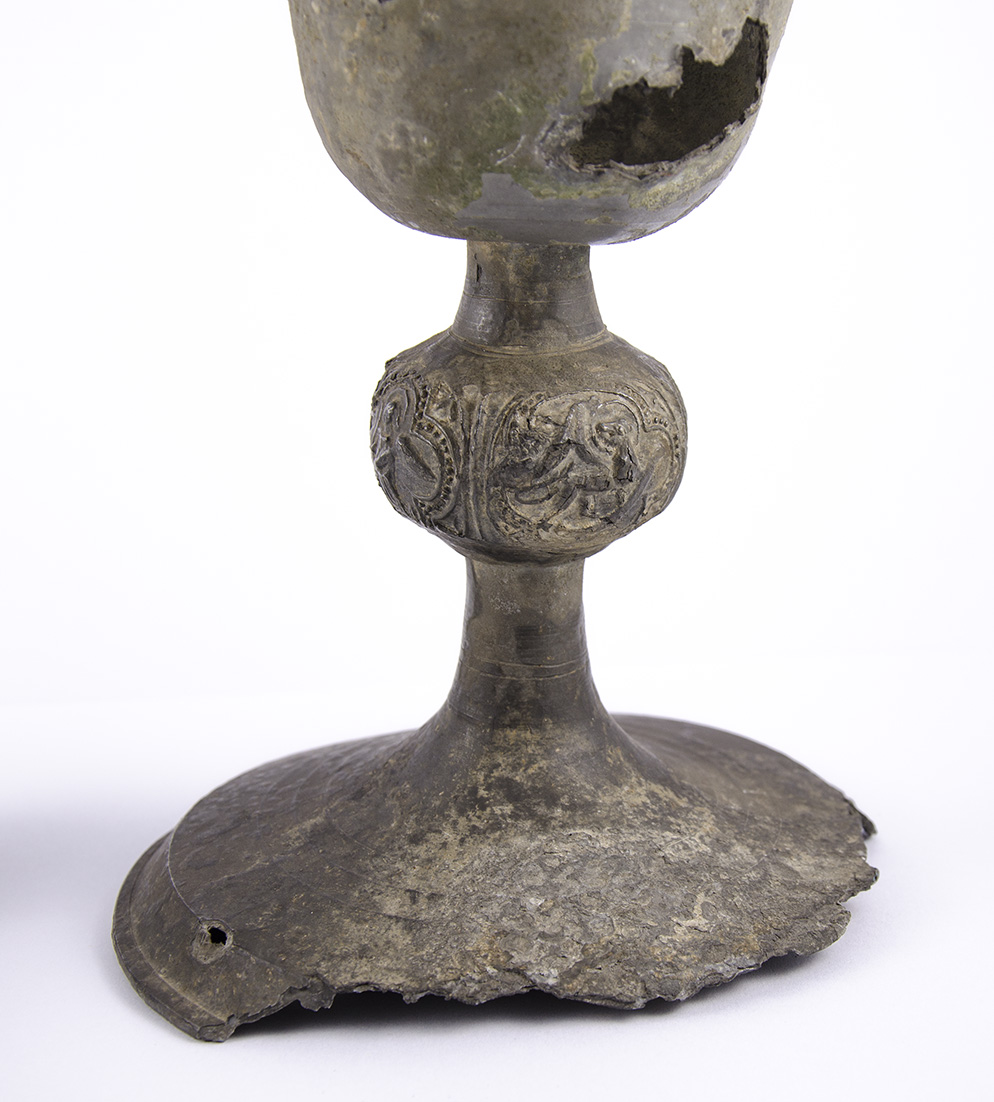
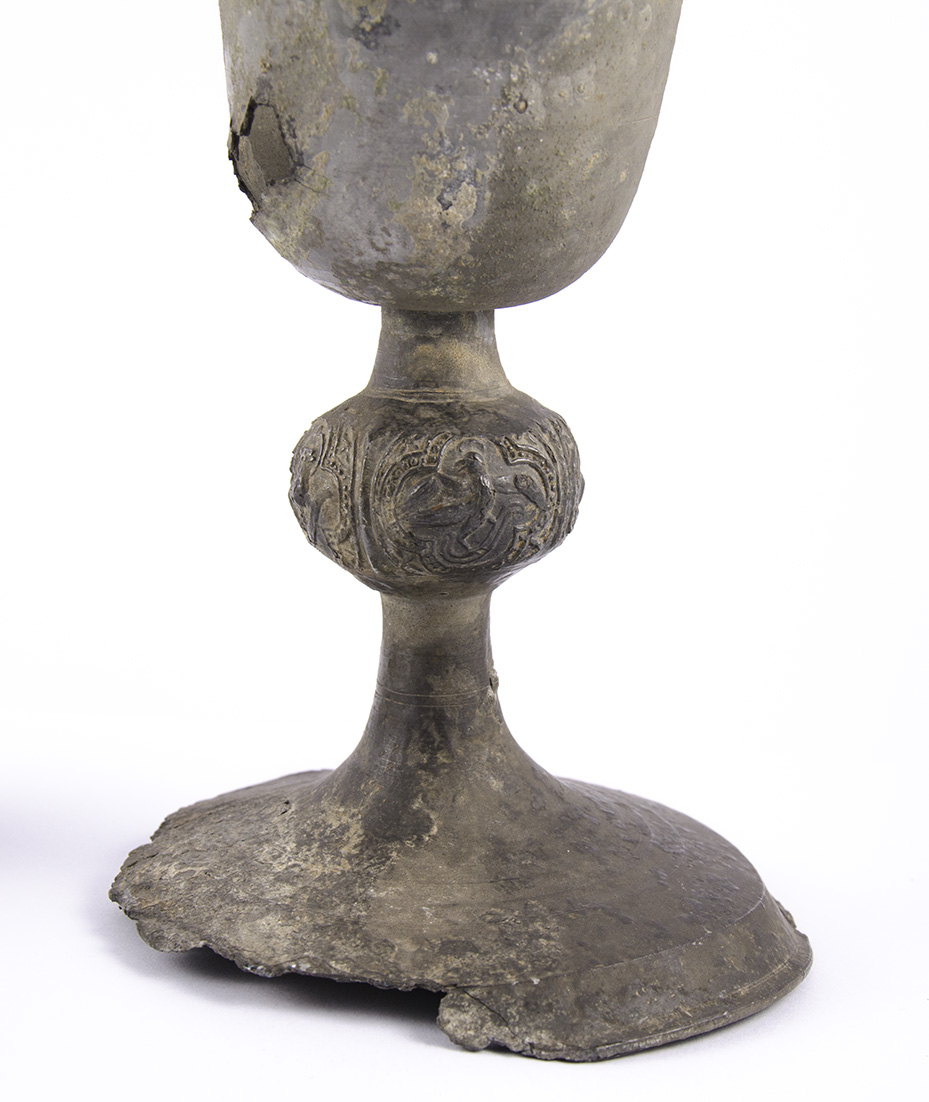
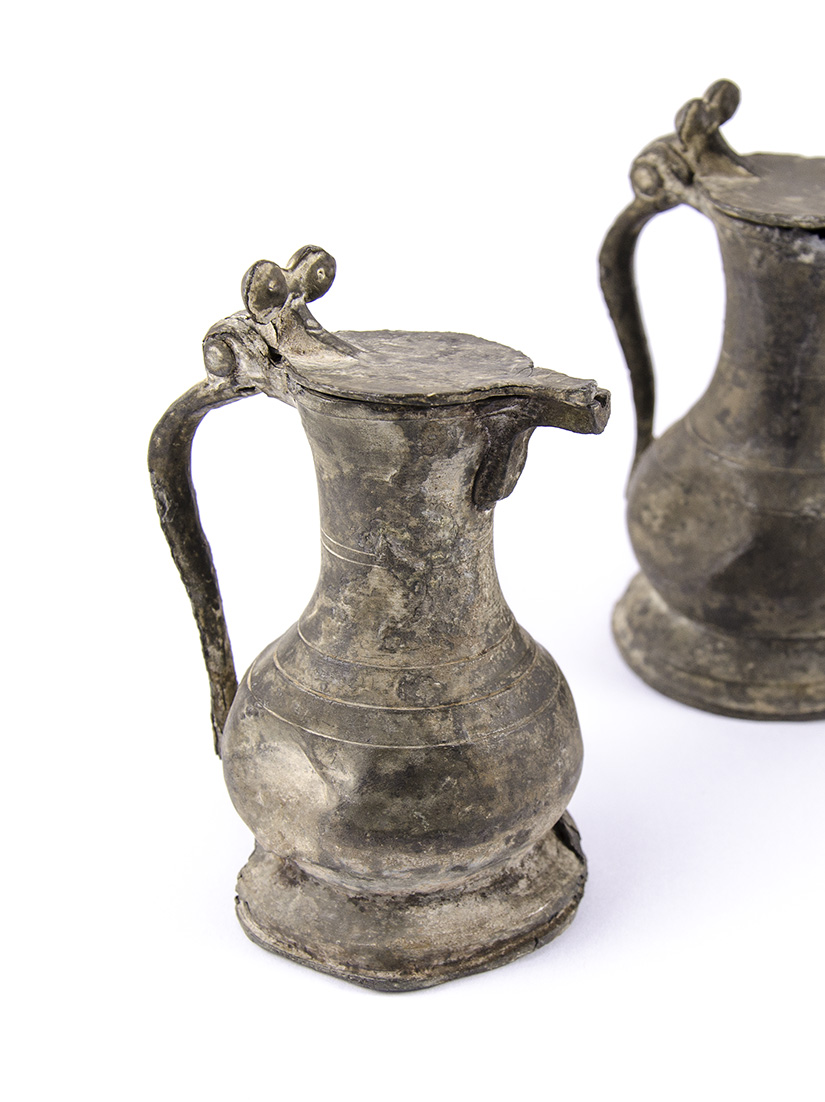
Chalice and cruets. Spain. 13th century.
This set, made of cast pewter, consists of a chalice and two cruets; all show signs of wear. The chalice, whose design follows one of the most widespread models of the 13th century, rises from a broad base with raised concentric bands and is decorated only at the knuckle, which is divided into four sections each containing a quatrefoil with dots and the symbols of the Tetramorph, all in relief. The cruets are plain, also featuring raised fillets, hinged lids, and curved handles, similar in design to those held by the Archaeological Museum of Madrid, unlike other examples adorned with coats of arms, some from Aragon and others from Castile and León. These pieces come from the church of Santo Tomás Cantuariense in Salamanca, as recounted by the historian and owner himself: While the undersigned was in the city of Salamanca in 1947 and in the aforementioned church, he witnessed the exhumation of these objects during the excavation of the tomb of a priest who died in the 13th century. He acquired it that same year. Héctor Schenone Collection.
The set was reproduced in the catalog of the Exhibition of History and Religious Art (Buenos Aires, 1948), items 175–176, p. 67.
According to Gabriela Siracusano, Eugenia Tomasini, and Claudia Puebla, “this would be the oldest set of its kind discovered in Spain to date.” (1)
Dimensions. Chalice, text-align: justify;margin-top:0pt;margin-bottom:0pt;">That church in Salamanca, Santo Tomás Cantuariense, was originally a Romanesque church whose construction was linked to the spread of the cult of Bishop Thomas Becket of Canterbury, one of the few English saints whose veneration spread throughout Catholic Europe. Interestingly, his canonization was very rapid, taking place just three years after his death, which explains the popularity of a figure who, in a way, embodied the struggles between temporal and ecclesiastical power.
In England, many churches were dedicated to him. Ten years after his death, another in Paris—now lost—stood on the site now occupied by the Place du Carrousel. He was very popular in Germany, especially in Hamburg, whose port maintained significant trade relations with the island. He was also highly venerated in Norway and Finland, as well as in Italy. His cult was introduced to Spain by Queen Eleanor, daughter of Henry II of England and wife of Alfonso III of Aragon, giving rise to the churches in Salamanca and Zamora.
Apparently, the collection of similar pieces found in Spain, as well as the custom of placing them in the tombs of priests, was common in certain regions of the peninsula, and it is unknown whether this practice was repeated in other parts of Europe. All of them are made of lead or tin, and, according to the information provided by Manuel Gómez-Moreno, they were also made of ceramic. These common materials distinguished them from liturgical objects made of precious metals, as they served only symbolically in the eternal Mass for the deceased.
The examples known to Schenone were: the collection kept in the archives of León Cathedral, originating from graves opened during renovations carried out in the late 19th and early 20th centuries, and those in the Archaeological Museum and the Royal Academy of History in Madrid—two chalices and cruets, the latter donated by Canon J. Corominas of Burgos.
In this regard, Gómez-Moreno reports that: The finest chalices date from the 13th century; they are elegant, with a wide bowl and small medallions depicting Calvary and symbols of the Evangelists, or heads at their knobs, and measure 16 to 18 centimeters in height […]. The cruets are of two types: smooth conical ones, or ewer-shaped with a long spout, handle, and lid, and their body is usually decorated with coats of arms (Monumental Catalog of Spain, Province of León 1906–1908, Ministry of Public Instruction and Fine Arts, Madrid, 1925, pp. 282–283, pl. 393).
Note: 1. Gabriela Siracusano, Eugenia Tomasini, and Claudia Puebla: The 13th-century Spanish chalice from the Schenone collection. An interdisciplinary approach from the perspective of the “archeology of making.” In Hilario magazine, issue 57, February 2026.
S.O.52-BLMM
| PRICE | U$S 4500 |
|---|
Are you interested in selling some works?
Send us an email briefly indicating
which works you intend to put on sale, and we will respond. click here
Subscribe to our newsletter to be updated.
Check our Newsletters