BACK TO TOP
ART
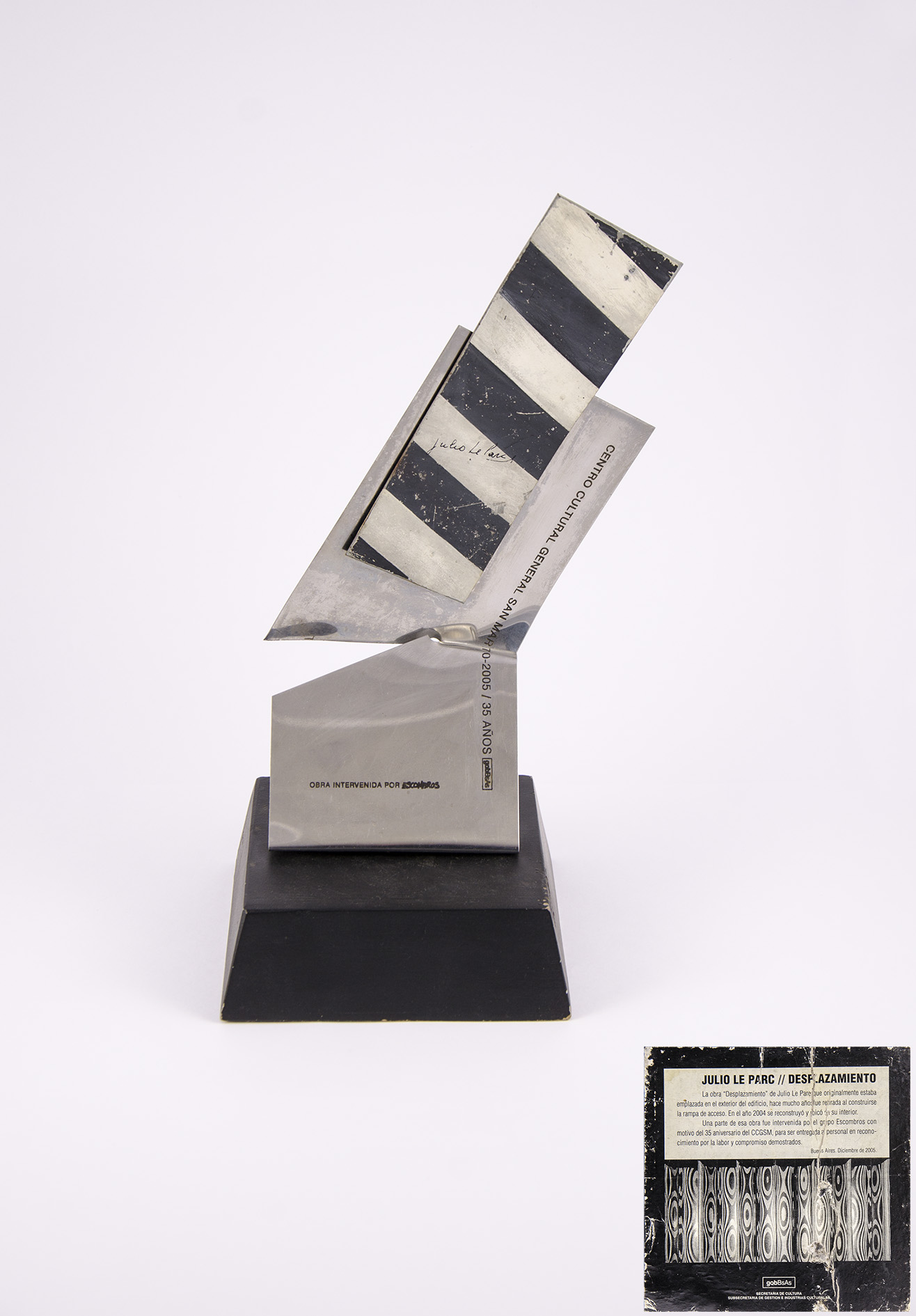
Displacement. 1967 / 2005.
Aluminum and steel on a wooden base. Signed artwork.
Measurements: Height: 29 cm. Width: 12 cm.
A label affixed to the back of the sculpture reads: “Julio Le Parc’s work ‘Displacement,’ which was originally located outside the building, was removed many years ago when the access ramp was built. In 2004, it was reconstructed and placed inside. A portion of this work was altered by the Escombros group to commemorate the 35th anniversary of the CCGSM and presented to the staff in recognition of their work and commitment. Buenos Aires. December 2005.”
Displacement is an emblematic kinetic art installation by the Argentine artist Julio Le Parc. Created in 1967, initially for the Di Tella Institute and donated to the San Martín Cultural Center for its inauguration in 1970, the work challenges static art by requiring the viewer to walk in front of it to activate it and generate virtual movement. The piece is composed of modules with undulating black and white lines. As the visitor moves, the distorted reflection of the lines creates the optical illusion of shapes that appear, disappear, or transform into circles. Displacement was a pioneer of "action art." In an era where the traditional painting was the norm, Le Parc transformed the observer into an active participant. The visitor's body and its movement are the true driving force of the visual experience.
As we read on the label, years later the work was disabled and finally removed for the construction of a ramp. In 2004, after years in a basement, it was recovered and restored by the Escombros group for installation inside the cultural center. The same group used fragments of the original work to create pieces for the center's staff. Here we see an original fragment of Displacement, measuring 17.2 x 6 cm, made of iron painted with black and white lines, which originally reflected on the mirrored plates. It is attached to another folded metal plate, both supported by a wooden base.
The Escombros Group is a renowned conceptual and performance art collective founded in the city of La Plata, Argentina, on July 9, 1988 (1). Defining themselves with the motto "Artists of what remains," the group emerged in a context of profound political, social, and economic crisis (marked by hyperinflation and neoliberalism), proposing a committed and critical art that used abandoned public spaces as its primary gallery. Several of the members of the Escombros Group had prior experience in conceptual art and the Argentine avant-garde of the 1960s and 70s, participating in the La Plata Group, the Diagonal Zero Movement, the happenings at the Di Tella Institute, and the Group of Thirteen at the Center for Art and Communication (CAyC).
What can be said about Julio Le Parc, who recently passed away at 97, just days before the opening of a major retrospective at the Tate in London? Le Parc received awards in Argentina and abroad, such as the Grand International Painting Prize at the 33rd Venice Biennale, but his greatest artistic contribution was achieved through his use of light and movement.
Note: 1. Initially comprised of Horacio D’Alessandro, Eduardo Edwards, Héctor Ochoa, Luis Pazos, Héctor Puppo, and Juan Carlos Romero.
S.O.53-LEM
| AUTHOR | JULIO LE PARC; GRUPO ESCOMBROS |
|---|
Are you interested in selling some works?
Send us an email briefly indicating
which works you intend to put on sale, and we will respond. click here
Subscribe to our newsletter to be updated.
Check our Newsletters